
What Lincoln’s dockside surprise taught us about Alabama’s most
misunderstood neighbor
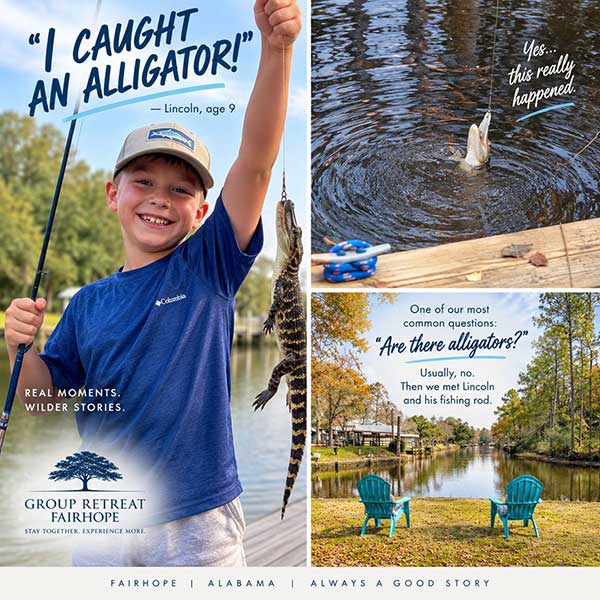
Guest Georgia sent us these photos after her grandson Lincoln, age 9, actually hooked a small alligator while fishing from the dock.
His reaction: pure joy, followed by the nine-year-old equivalent of a victory lap.
“I caught an alligator!”
Fair enough. I lived here for 3½ years and never saw one. Longtime neighbors say they hadn’t either.
We have, however, hosted an alligator hunter before. Alabama has a regulated alligator season, and Baldwin County south of I-10 is part of the state’s Coastal Alligator Management Area.
Lincoln still holds the distinction of being the first guest we know of to hook one from the dock.
SO… WHY NOW?
We’ve had a tremendous amount of rain.
That may actually matter.
American alligators generally prefer freshwater, but USGS notes that some alligators venture into brackish habitat during wet periods because increased rainfall lowers salinity and makes the water more tolerable.
So the idea that our normally brackish waterway became a little more inviting after months of rain is not just neighborhood lore.
ALLIGATOR FAST FACTS
- They’re Alabama natives. Alligators occur statewide, with higher densities in coastal marshes, swamps, lakes and rivers; Alabama also notes that they can show up in man-made canals and neighborhoods near water.
- They can live about 50 years in the wild.
- They are excellent mothers. Females guard their young for years, and babies remain near their mother after hatching.
- Baby alligators chirp before they even hatch. Mom hears those high-pitched calls and starts uncovering the nest.
- They’re ecosystem engineers. Their trails and “gator holes” create dry-season refuges for fish and other wildlife and provide habitat used by birds, turtles and snakes.
- They’re top predators. Alabama wildlife officials say they help keep other animal populations in balance.
- They go through a lot of teeth. An alligator may replace roughly 3,000 teeth over its lifetime.
DO THEY HELP CONTROL NUISANCE SPECIES?
Yes, in the broad ecological sense.
Alligators are opportunistic predators. Alabama lists prey ranging from fish, snakes and turtles to nutria, feral pigs and deer. As top predators, they help keep prey populations from becoming badly unbalanced.
I wouldn’t call them specialized pest control.
They’re just doing their job.
ARE THEY AGGRESSIVE?
Usually, no.
My grandmother grew up swimming Mississippi rivers with alligators around and always said they mostly wanted nothing to do with people.
Modern wildlife guidance sounds remarkably similar: Alabama describes alligators as naturally shy of humans, although they can become aggressive if they’re harassed, provoked or fed.
The most recent well-documented Alabama injury I found was at Lake Shelby in Gulf State Park in 2004, when a Baldwin County man was bitten while swimming and needed 20 stitches.
That was more than two decades ago.
Which doesn’t mean you treat an alligator like a Labradoodle.
It does mean the horror-movie version and the everyday Gulf Coast reality are not quite the same thing.
ALLIGATOR OR CROCODILE?
In Alabama, you’re looking at an American alligator.
American crocodiles in the United States are a South Florida animal, and they’re a different species entirely. Their snouts are narrower, and their lower fourth tooth remains visible when the mouth is closed; alligators have the broader, rounded snout most of us recognize.
And while crocodiles have the scarier global reputation, much of that comes from species such as Nile and saltwater crocodiles—not Florida’s American crocodile.
HUNTING SEASON IN ALABAMA
Alabama’s alligator hunt is tightly regulated and permit-based.
For 2026, the state has five management areas, including the Coastal Management Area covering Baldwin and Mobile counties south of I-10. Hunting is limited to designated dates and nighttime hours, and successful applicants need permits, training and harvest tags.
So yes, the alligator hunter we hosted in 2025 was participating in a very real Alabama tradition.
Just one involving considerably more paperwork than Lincoln’s fishing afternoon.
WANT TO SEE THEM ON PURPOSE?
We apparently spoke too soon about keeping alligator encounters safely elevated and dry.
Our earlier facebook post featured Gator Alley Boardwalk in Daphne, where an elevated walkway gives you a much more civilized way to look for them.
Lincoln, apparently, preferred the hands-on curriculum.
SOURCES & FURTHER READING
Outdoor Alabama — Living with Alligators
Outdoor Alabama — Alligator Season
USGS — American Alligator / wet-season use of brackish habitat
USGS — American Alligator Ecology and Monitoring
Smithsonian’s National Zoo — American Alligator